So to the essential key question: Was the Agile Transformation successful?
Hitting the objectives
In terms of doing what it set out to do, the 2003 Transformation programme did indeed deliver those things, and also came in under budget into the bargain. One result that possibly contributed to this and was quite surprising compared to the incoming assumptions was that 100% of the people who were slated to relocate from Dudley to Derby did indeed choose to do so (compared to the planning assumption that 30 people would choose not to relocate).
To assess its success and achievements of the targets set for itself, we need to look back over the data available to make the judgment. The information comes in a number of different pieces [Egg loved surveys, by the way]:
- Egg Agile customer survey
- Great Place to Work (GPTW) surveys
- Egg Money Manager publicity
- The Egg Loans 2003 story
Egg Agile Customer Survey
We asked 17 business people on agile projects for feedback on the Agile Egg approach, and gathered their opinion on these key statements:
- “Agile Egg approach helped to get software that matched your initial proposition”
- “Agile Egg approach increased visibility of project progress”
- “Agile Egg approach helped you to control costs”
- “Agile Egg approach helped you to predict delivery dates”
- “Agile Egg approach helped reduce defects in delivered software”
- “You had the support needed to perform your role in the Agile Egg process”
General likes:
The agile process did allow for rework of the interface following usability testing (user testing) which is great
Story studio , stand ups and constant feedback from developers are big wins for egg
Much more fun than waterfall
Had the benefit of working with great teams
Acceptance Test Driven development and planning – we love that!
Onsite customer, Test first, Planning game
Big Visible Displays
I like the approach, you get what you want the way you want it generally.
What was still not right:
Ability to transition to live Perhaps more emphasis up front on the possible issues and dependencies that may exist
The truth role needs to be an analysis role where the person used has had adequate analysis training, otherwise scenarios are overlooked and solutions not put in place
There is still a need for design documentation that can be shared in the business community
Tendency to not see the full picture, so essential to have process engineering involvement at the outset
We need to look again at the way we manage testing, and how the business are involved in prioritisation
XP Story Studio further work – integrating Test Director tool
Not convinced that Agile always works well in banking/ corporate context – where there are strict requirements re delivery dates, regulations, legal requirements etc flexibility can be compromised. Proper kick off meeting with the right people in attendance would be very useful.
Project initiation –context sharing sessions
Huge disparity between quality of outcome managers and project Truths
Everyone seemed to have a different opinion on what Agile was all about.
Looking at the numbers…
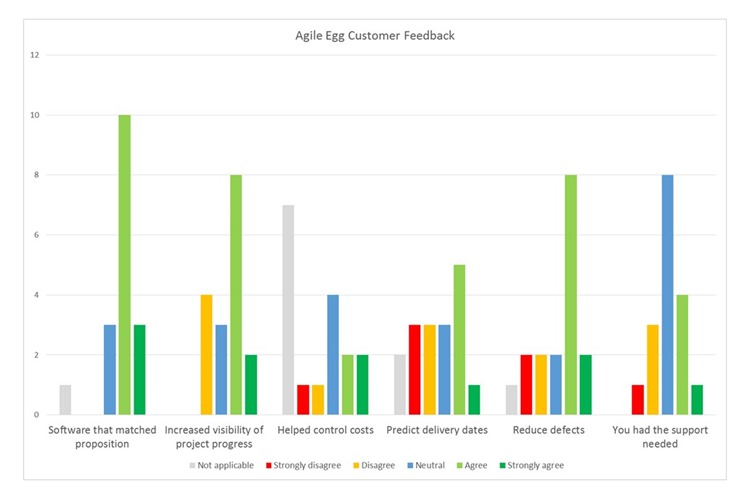
Looking more closely at the chart we can see that, in terms of the median response then in terms of positive responses:
- Software that matched proposition: >80% agreed with this
- Increased visibility of project progress: 59% agreed with this
- Reduce defects: 63% agreed with this
whereas the result was more muted for
- Predict delivery dates: 40% agreed here
- You had the support needed: 29% agreed with this, although nearly 50% were neutral
- Helped control costs, 40% agreed with this, with nearly 50% saying it was not applicable to them [that lack of interest in managing costs was an interesting result all of itself!]
The positive responses confirm what we would hope to see out based on the theory of what Agile methods and modern development techniques deliver.
The observation about “predicting delivery dates” is actually a disconnect of sorts between old World, waterfall delivery of a fixed feature set in a fixed time and New World, agile thinking as the iterative method deliberately chooses to vary the feature set in favour of fixing costs and quality.
The observation on “You had the support needed” needs a bit digging into the survey verbatims and actually points to the issue of the understanding of Agile thinking and buy-in by the Egg business people, as we have already observed in the methods section. Looking deeper, the result here certainly indicates a need for the Agile thinking to suffuse completely into the natural way of working across the whole business, and not just being an IT “thing” .
You can read more here…
Great Place to Work Surveys
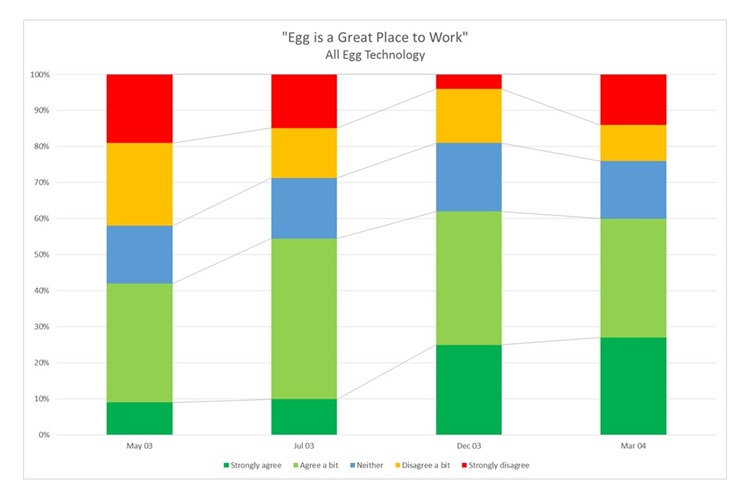
As mentioned in Great People, being a Great Place to Work was a key strategic drive for Egg as a whole in 2003/4, to get to the result that 8/10 said just that. Looking at the Egg Annual Report: Egg had by the end of 2004, managed to move the pointer to 71% from 37% in March 2003. Didn’t get to 80% but still a good result, and perhaps with hindsight, this might have been a more difficult objective than had been expected, but, hey, that was Egg!
The surveyed results in Egg Technology show the same trend…
… and also in ETS….
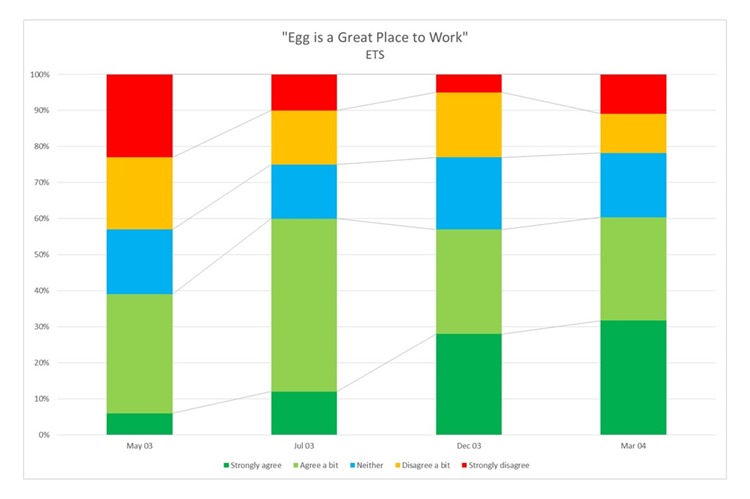
Up to the end of 2003, the survey results show a strong upward trend, with the biggest step at the start moving from 39% “agrees” in May’03 to 60% in July, after the main disruption of the reorganisation and ETS was launched. There is a consistent fall in “disagrees” from 43% to 22% between 2003 and 2004, and in that same period, “strongly agrees” rose to 32%.
So, whilst it wasn’t 80% positively agreeing, including the 15-20% who were non-committal, then at least there were 78% of people who were not actively disagreeing that Egg was a Great Place to Work…
Egg Money Manager Publicity
You can see the way that Agile development was promoted as a business benefit in the news items in the News Archive which generally talk about the acceleration of time to market.
Underneath the covers, the Egg Money Manager V2 project was an excellent example of how agility and modern development techniques can deliver a high quality product quickly.
In Oct 2003 the project team set a live date of 1st April for the launch of Egg Money Manger – the launch was in fact a week ahead of schedule, with a successful first-time release as well as being under budget.
The team extended Egg’s Agile methodology by using Acceptance Test Driven Planning to define, estimate and run its iterations. The team left a legacy of 240 acceptance tests for the system for ongoing software assurance.
The team successfully implemented test driven development which gave a zero defect count when releasing into system test. This was also reflected with a ‘right first time’ journey through the “Transition to Live” (TTL) process.
The acceleration was no mean feat as it allowed Egg to scoop FirstDirect who were also developing a similar service, which was already underway before Egg started, with Egg launching earlier than FirstDirect
All in all, a jolly good show!
Egg Loans 2003 story
Whilst Egg Money Manager got the lion’s share of promotion, Egg Loans was also one of the programmes that benefited from a significant amount of investment, and also used Agile Egg methods. The 2003 Loans programme generated a significant multi-million contribution to Egg’s bottom line [OK, so we won’t mention PPI, just read what Steve Townend said about that ] with volume growth of 80% and customer satisfaction consistently over 80%.
The development work included:
- Massive increase in automation
- Improved support for credit decisioning
- Reduced response times and code clean-ups
We can surmise that with the old ways the work would have taken six months to a year longer, and so the contribution by the faster time to market was to double the ROI, with an overall incremental contribution of £20-30m being generated by the acceleration.
Running the ruler
So what does all this mean in terms of the Agile Transformation. To reprise, then, the essential Conditions of Satisfaction were these:
- Egg Technology Solutions is perceived to be more productive
- measured by increase in internal customer satisfaction (and)
- Target 33% developer productivity increase for flat costs
- Egg Technology has a real partnership with the rest of Egg – measured by internal feedback
- 8/10 of Egg Technology people say it is a great place to work (in 2003)
Productivity?
In terms of internal customer satisfaction, the feedback received certainly indicated that the new ways of working were delivering the propositions the product people wanted, with a lower level of defects and better visibility on progress than before – which is GOOD.
The 33% target increase in developer productivity is, as it turns out, not a helpful target but was, at the time, how we tried to quantify the productivity in the absence of any useful data, as it turned out; the basis was a hypothetical productivity baseline of “useful coding days” and and assumed synthetic target increase on that output that was not later measured in that way at all.
So we need to look elsewhere for the answer to this question and the Egg Money Manager and Loans stories point the way to a much better view of the true value of the increased productivity of a well-integrated business and IT team generating real monetary value by doing things, faster, quicker, better – which is GOOD
Partnership with the rest of Egg?
This is a tough one to call as we only have the data above to make the judgment. The customer feedback, EMM experience and the Loans story certainly shows that when the business people “got it”, however there was also clearly progress to be made on building the proper supports across the business for a fully agile Egg. This theme was addressed for change agents , at least, by the following integration in the Change and Execution organisation.
So I would say this is a qualified OK, or a curate’s Egg [sorry], and so GOOD in parts and so I think we need some further opinions, perceptions, and even 20:20 hindsight with which to complete this judgment – please do add your comments below!
Great Place to Work?
Whilst the fabled “8 out of 10 people” target was not reached, the results here generally say that the Agile Transformation did make a huge difference – which is GOOD!
In Summary…
The Agile Transformation did succeed in bringing about new ways of working and was a major step on the path to changing the shape of Egg Technology…
What do you think? Do add your comments below!